
Want more ideas and freebies?
Get my free resource library with digital & print activities—plus tips over email.
Join for Free Resources →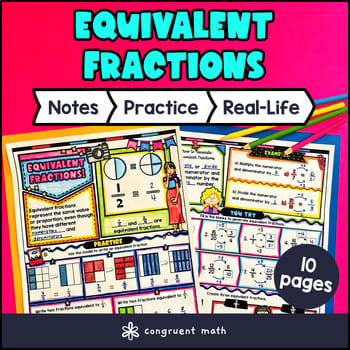
$4.25
Ever wondered how to teach equivalent fractions in an engaging way to your 4th grade students?
In this lesson plan, students will learn about equivalent fractions and their real-life applications. Through artistic, interactive guided notes, checks for understanding, a color-by-code activity, and a maze worksheet, students will gain a comprehensive understanding of equivalent fractions.
The lesson culminates with a real-life example that explores how equivalent fractions are used in everyday situations, helping students connect math to their world.
$4.25
After this lesson, students will be able to:
Before this lesson, students should be familiar with:
As a hook, ask students why it might be helpful to have different fractions that represent the same amount. For example, ask, “Have you ever shared a pizza with friends and noticed different ways to describe the same-size slice?” Refer to the last page of the guided notes, which discusses real-life uses of equivalent fractions, as well as the FAQs below for additional ideas and context.
Use the first page of the guided notes to introduce what equivalent fractions are by showing visual fraction models. Walk through how the models show that two or more fractions can look different but represent the same portion of a whole. Highlight that the shapes in the models are divided differently yet shaded equally, reinforcing the idea of equivalency. Refer to the FAQ below for a walkthrough on guiding students to understand this concept, as well as strategies for addressing common misconceptions such as confusing equivalent fractions with fractions that simply look similar.
Use the second page of the guided notes to introduce the numeric method for generating equivalent fractions. This involves multiplying the numerator and denominator of a fraction by the same number. Walk through several examples step-by-step, clarifying why this multiplication does not change the fraction’s value. Emphasize the connection between this numeric process and the visual models from the first page. Refer to the FAQ below for detailed explanations about this procedure and suggestions on how to respond to common student questions, such as why multiplying both parts by the same factor works.
Based on student responses during the checks for understanding integrated into the guided notes, reteach any concepts that students struggle with—whether they have difficulty interpreting the visual models or the multiplication process. If your class has a wide range of proficiency levels, consider pulling students aside who need extra support for targeted reteaching, while inviting more advanced students to begin working on the practice exercises to deepen their understanding.
Have students practice equivalent fractions using the color by code and maze activities. Walk around to answer student questions.
Fast finishers can dive into the problem sets for extra practice. You can assign it as homework for the remainder of the class.
Bring the class back together, and introduce the concept of how equivalent fractions are used in cooking and baking when adjusting recipes. Explain that sometimes recipes need to be doubled or halved, and understanding equivalent fractions helps in measuring ingredients correctly. Show examples like doubling 1/2 cup to 2/2 cups (which is equivalent to 1 cup) or halving 3/4 cup to 3/8 cup. Refer to the FAQ for more ideas on how to teach it!
A fun, no-prep way to practice equivalent fractions is Doodle Math — it’s a fresh take on color by number or color by code. It includes multiple levels of practice, perfect for a review day or sub plan.
Here is 1 activity to try:
Get my free resource library with digital & print activities—plus tips over email.
Join for Free Resources →