
Want more ideas and freebies?
Get my free resource library with digital & print activities—plus tips over email.
Join for Free Resources →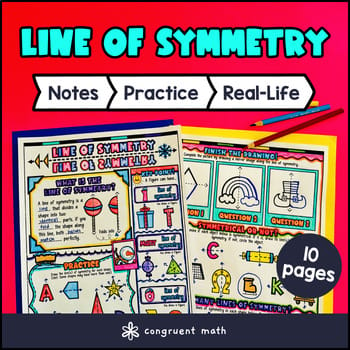
$4.25
Ever wondered how to teach lines of symmetry in an engaging way to your 4th grade students?
In this lesson plan, students will learn about symmetrical lines and their real-life applications. Through artistic, interactive guided notes, checks for understanding, a maze worksheet, and practice problem sets, students will gain a comprehensive understanding of identifying and drawing lines of symmetry in 2D figures.
The lesson culminates with a real-life example that explores how recognizing symmetry helps in design and nature, reinforcing the relevance of this math skill.
$4.25
After this lesson, students will be able to:
Before this lesson, students should be familiar with:
As a hook, ask students if they have ever noticed objects or shapes that look the same on both sides when folded, like a butterfly’s wings or a perfectly folded paper snowflake. Invite them to think about why some shapes have this property and others do not. Refer to the last page of the guided notes as well as the FAQs below for additional ideas or questions to spark curiosity.
Use the first page of the guided notes to introduce the concept of a line of symmetry. Explain that a line of symmetry divides a shape into two mirror-image halves. Walk through key points such as: what it means for a figure to be symmetrical, how to visually identify lines of symmetry by folding or imagining a fold, and examples of simple shapes with one or more lines of symmetry. Refer to the FAQ below for guidance on how to demonstrate these ideas effectively and how to respond to common student questions, such as "Can a shape have more than one line of symmetry?" or "What happens if the halves don’t match perfectly?"
Use the second page of the guided notes to deepen understanding by showing how to draw a line of symmetry on various two-dimensional figures. Lead students through the guided checks for understanding embedded in the notes, ensuring they can identify and sketch lines of symmetry accurately on common shapes like rectangles, squares, circles, and triangles. Discuss examples of non-symmetric figures as well, reinforcing the idea that not all shapes have lines of symmetry. Again, refer to the FAQ below for tips on scaffolding this instruction and handling typical student challenges, such as confusion between symmetry and congruence.
Based on student responses during these guided note activities, reteach concepts that need reinforcement. For example, if many students struggle with visualizing symmetric halves, provide hands-on folding activities or use mirrors to illustrate the symmetry more concretely. If your class exhibits a wide range of proficiency, consider pulling aside students needing extra support for focused reteaching, while encouraging more advanced learners to begin exploring the practice exercises independently.
Have students practice lines of symmetry using the maze activity. Walk around to answer student questions.
Fast finishers can dive into the problem set worksheet activity for extra practice. You can assign it as homework for the remainder of the class.
Bring the class back together, and introduce the concept of symmetry in nature and everyday objects. Discuss how lines of symmetry can be found in things like butterflies, leaves, buildings, and artwork. Show examples of these real-world objects and ask students to identify or draw the line(s) of symmetry. Encourage them to think about how symmetry helps with design, balance, and function. Refer to the FAQ for more ideas on how to teach it!
If you’re looking for digital practice for lines of symmetry, try my Pixel Art activities in Google Sheets. Every answer is automatically checked, and correct answers unlock parts of a mystery picture. It’s incredibly fun, and a powerful tool for differentiation.
Here’s 1 activity to explore:
Get my free resource library with digital & print activities—plus tips over email.
Join for Free Resources →