
Want more ideas and freebies?
Get my free resource library with digital & print activities—plus tips over email.
Join for Free Resources →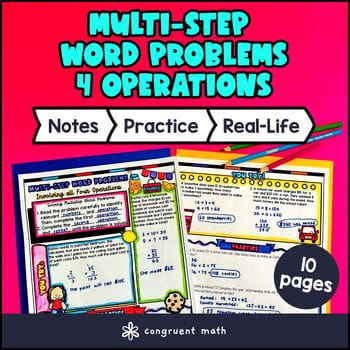
$4.25
Ever wondered how to teach multistep word problems in an engaging way to your 4th grade students?
In this lesson plan, students will learn about solving multistep word problems using all four operations and their real-life applications. Through artistic, interactive guided notes, check for understanding, a color by code activity, and a maze worksheet, students will gain a comprehensive understanding of multistep problem-solving.
The lesson culminates with a real-life example that explores how these skills apply to everyday math situations, helping students see the practical value of their learning.
$4.25
After this lesson, students will be able to:
Before this lesson, students should be familiar with:
As a hook, ask students why it might be important to solve problems that require more than one step—such as figuring out how much money is left after buying several items or how many groups of something they can make after dividing a total amount. Refer to the real-life math application page at the end of the guided notes as well as the FAQs below for ideas and examples to spark this discussion.
Use the first page of the guided notes to introduce what multistep word problems are, emphasizing that these problems require more than one operation (adding, subtracting, multiplying, or dividing) to find the solution. Walk through key points such as identifying what the problem is asking, deciding which operations to use, and the importance of following the steps in order. Highlight the guided examples and checks for understanding to ensure students grasp this process. Refer to the FAQ below for a detailed walk-through and strategies for addressing common student misconceptions, such as confusing the order of operations or missing key details in the problem.
Use the second page of the guided notes to deepen students’ understanding by guiding them through more complex multistep problems that combine all four operations. Focus on strategies like underlining important information, writing down intermediate answers, and checking their work before moving to the next step. Walk through sample problems that model this approach clearly, stopping frequently to ask questions that check for understanding. Refer to the FAQ below for additional prompts and guidance on supporting students who struggle with multi-operation thinking or lose track of steps.
Based on student responses during these guided notes sessions—especially the built-in checks for understanding—reteach concepts where needed. For example, if students seem unsure when to multiply or divide, revisit those steps with simpler examples before progressing. If your class has a wide range of proficiency levels, consider pulling out small groups for targeted reteaching while allowing more advanced students to begin preliminary practice exercises independently.
Have students practice multistep word problems using all four operations with the color by code and maze activities. Walk around to answer student questions.
Fast finishers can dive into the problem sets activity for extra practice. You can assign it as homework for the remainder of the class.
Bring the class back together, and introduce the concept of using multistep word problems to solve real-world situations involving everyday tasks such as budgeting money, planning events, or sharing items equally. Explain how these problems reflect decisions people make using addition, subtraction, multiplication, and division together to find solutions. Refer to the FAQ for more ideas on how to teach it!
If you’re looking for digital practice for multistep word problems with all four operations, try my Pixel Art activities in Google Sheets. Every answer is automatically checked, and correct answers unlock parts of a mystery picture. It’s incredibly fun, and a powerful tool for differentiation.
Here’s 1 activity to explore:
Get my free resource library with digital & print activities—plus tips over email.
Join for Free Resources →